Challenge Name:
Minos 7: Takedown
Category:
Malware
Challenge Description:
Tid til at få K-Pop Gremlin Hunters på banen, it's takedown time.

Gad vide om backenden gemmer på en selvdestruktionsmetode til nødsituationer, vi kan udnytte, der ikke er eksponeret i panelet. Hmm... håber ikke dine reversing skills er for rustne.

https://tryhackme.com/jr/minos
This final challenge strongly hints at:
- A hidden backend endpoint
- A self-destruct / emergency takedown feature
- Needing binary reversing, not just web fuzzing
Approach
At this point, we already have:
- Arbitrary file read
- Arbitrary command execution on the server
- Full access to the Minos panel backend
So the question becomes:
Is there functionality in the backend that is not exposed via the panel UI?
The hint suggests yes, and that we need to reverse the backend itself.
Finding the backend binary
Using our existing RCE, I modified the custom restart script to enumerate executables related to minos:
echo "== Candidate executables named *minos* under /usr (depth 5) =="
find /usr -maxdepth 5 -type f -perm -111 -iname '*minos*' 2>/dev/null || echo "no *minos* executables under /usr"
echo
The output revealed two relevant binaries:
== Candidate executables named *minos* under /usr (depth 5) ==
/usr/local/minos/bin/minos
/usr/local/minos/bin/minos-server
I downloaded both and inspected them, turns out that the first is the panel website. The second is a C2 server that corresponds to the C2 client in tasks 1-4.
Inspecting the server binary
Using the arbitrary file download vulnerability, I extracted the server binary: Minos server executable
To avoid unnecessary efforts, I started with a simple strings pass instead of a full decompile: Minos server executable strings output
This already paid off.
Discovering the Takedown page
Inside the strings output, I found an entire HTML page embedded verbatim: takedown.html
If we managed to call the page, the Decoding box would change to our flag:
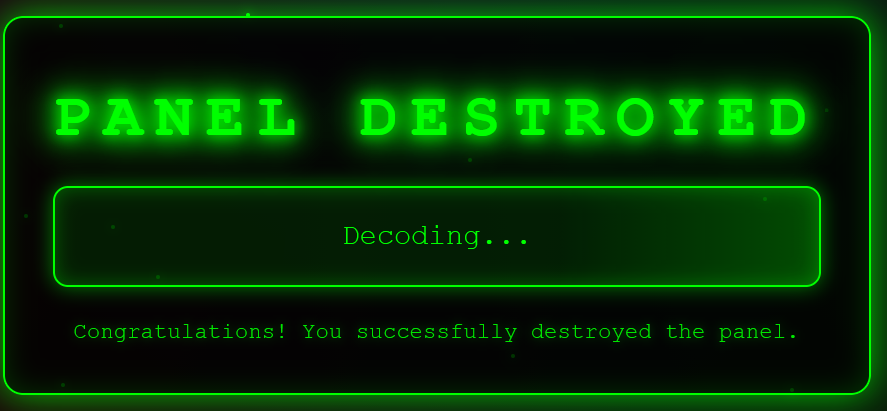
The page itself does not contain the flag directly, but it does contain a JavaScript decoder:
        // Decode the flag using XOR cipher
        function decodeFlag(encodedHex, key) {
            const bytes = [];
            for (let i = 0; i < encodedHex.length; i += 2) {
                bytes.push(parseInt(encodedHex.substr(i, 2), 16) ^ ((i / 2) + 1) % 256);
            }
            return bytes.map(b => String.fromCharCode(b)).join('');
        }
What this does
- The flag is stored as a hex string
- Each byte is XORed with an incrementing counter:
- Byte 0 XOR 1
- Byte 1 XOR 2
- Byte 2 XOR 3
- And so on
- The result is converted back to ASCII
So now we know:
- The flag is stored encoded in hex
- Somewhere in the backend, that hex blob, or a reference to it, must exist
Finding the hidden endpoint
Searching further through the strings output for API paths, I found a long concatenated list of routes that included this suspicious entry:
/api/v2/private/secret/op-endgame/takedown
That path is:
- Not present in the UI
- Not present in earlier tasks
- Perfectly named for this challenge
Calling the takedown endpoint
Step 1: Basic request
GET /api/v2/private/secret/op-endgame/takedown
Response:
405 Method Not Allowed
allow: POST
Step 2: POST without body
POST /api/v2/private/secret/op-endgame/takedown
Response
415 Unsupported Media Type
Expected request with `Content-Type: application/json`
Step 3: POST with empty JSON
POST /api/v2/private/secret/op-endgame/takedown
Content-Type: application/json

{}
Response:
{"success":false,"data":{"error":"Invalid confirmation","code":"INVALID_REQUEST"}}
So the endpoint exists, but expects a confirmation value.
Recovering the encoded flag
Searching again through the strings output for related error messages, I found this sequence:
messageBot deleted successfullybot_id.infoevent src/api/handlers.rs:1243minos_backend::api::handlerssrc/api/handlers.rsevent src/api/handlers.rs:1254event src/api/handlers.rs:1249event src/api/handlers.rs:937event src/api/handlers.rs:932confirmInvalid confirmationFailed to delete bots: Failed to delete tasks: 4f41307f7532693b65557f38663d6b20667c4c207b72486b2a686d2f6f416b144a47135216545a<!DOCTYPE html>
That last part is clearly hex-encoded data.
Decoding the Flag
Using the XOR logic from the embedded JavaScript, I recreated the decoder in Python:
def decode_flag(encoded_hex: str) -> str:
    out = []
    for i in range(0, len(encoded_hex), 2):
        b = int(encoded_hex[i:i+2], 16)
        k = ((i // 2) + 1) % 256
        out.append(chr(b ^ k))
    return "".join(out)

print(decode_flag("4f41307f7532693b65557f38663d6b20667c4c207b72486b2a686d2f6f416b144a47135216545a"))
Output:
NC3{p4n3l_t4k3d0wn_4nd_s3rv3r_t4ke0v3r}
Flag
NC3{p4n3l_t4k3d0wn_4nd_s3rv3r_t4ke0v3r}
The intended path (Post-solve insight)
After speaking with the challenge creator, it turns out the intended approach was to fully reverse the Rust backend binary.
If you do that, you find the expected JSON payload:
{"confirm":"DELETE_ALL_BOTS_AND_PANEL"}
The server responded with
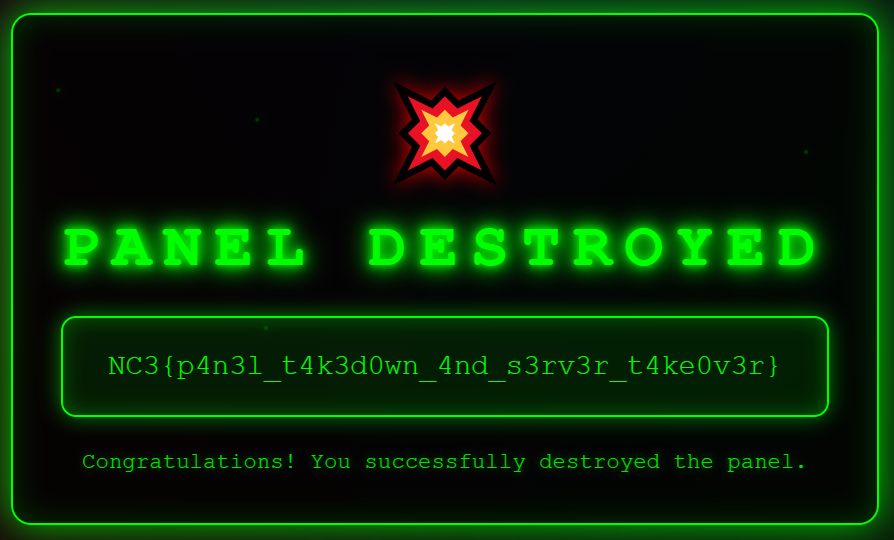
{"success":true,"data":{"message":"Congratulations, you destroyed the panel, checkout the splashscreen"}}
Reloading the front page then displays the proper “Panel destroyed” splash screen:
Reflections and Learnings
- Hidden endpoints are real: Production backends often contain emergency or admin-only routes never exposed in UIs.
- Strings analysis still matters: Even without a full decompile, strings revealed HTML, JavaScript, API paths, and encoded secrets.
- “Confirmation” != security: Obscure magic strings do not replace authentication or authorization.
- Multiple valid solution paths: Full reversing vs. partial extraction + crypto reuse both led to success.
- Excellent series finale: This challenge tied together web exploitation, server compromise, and binary reversing into a coherent takedown narrative.